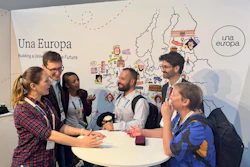
Ademiku, what motivated you to apply to the Una Europa Sustainability for All Summer School?
I love to travel, so seeing an opportunity to go to Ireland, Finland or somewhere else drew my interest. When I saw the Summer School, and that it was focused on sustainability, a key focus of my PhD research, I just knew I had to give it a shot.
I was captivated by the fact that the summer school included many different activities, from a group capstone project, poster presentations, workshops, and the Values and Impact Showcase, to interconnections with different PhD students from across Europe. It made me think that I could experience something really unique, to meet fellow PhD students and gain in-depth knowledge on sustainability. That was my main motivation.
Interdisciplinarity is a core feature of Una Europa Summer Schools. How is interdisciplinarity relevant to your own research?
My PhD is in agriculture, rural and environmental studies, which is inherently interdisciplinary. Specifically, my research is on underutilised crops, trying to understand the behaviour of both farmers and consumers towards them. These crops are nutritious and majorly climate resilient, ensuring sustainability for farmers as well as for consumers, be they horses or people.
We are in a climate change era; we need to work with farmers to understand how they can plant sustainably, not only in terms of the environmental benefits but also in economic aspects. Speaking of economic aspects brings the law in as well, linking policy made at national and international levels to local farmers in those rural, or sometimes urban, communities.
Interdisciplinarity is core to my research. It means I’m not studying food or crops alone – I’m studying how policy can influence the decisions that farmers make when adopting a crop, or how the economic priorities and policy of a nation can affect the decisions of the farmer or the consumer towards a particular crop. I try to put myself into a position where I can learn about the different aspects influencing food security, from international law, economics, geopolitics and more; to gain that interdisciplinary knowledge is important because that is what is needed. So I was happy to be exposed to this mindset at the Summer School, as well.
" When communicating your research, make sure to focus on the aspect that matters most to the person you are communicating it to – not what you feel or what you have done so far. "
Ademiku reflecting on the lessons he will take home from the Summer School.
You were named the winner of the Value and Impact Showcase during the Summer School (congratulations!).
How did you find the experience of presenting your research to your fellow researchers?
I was super excited. First of all, to be selected as one of 13 PhD students from 11 of Europe’s top universities to present at the Showcase was quite a motivation for me. And truly, I wasn’t expecting to win – I am only eight months into my PhD, in my first year, so I just wanted to give it a try.
Learning how to present research in a dynamic way is something that I feel all universities should encourage. Researchers are not just boxed behind a screen publishing papers – learning to communicate their research well really, really matters too. This Summer School exposed me to new ideas for communicating research in creative ways, so being named as winner was so thrilling to me.
But it’s not just about winning – the contribution of others and the feedback [from the Showcase panel] was so informative as well. One professor shared with me how struck he was that I was able to personalise my research, to show how it connects to people and their emotions. It was so exciting to me to receive that feedback.

Ademiku at University College Dublin for the Summer School.

Trying hurling, Ireland’s official national sport for men.

Ademiku receiving his certificate for winning the Values and Impact Showcase.

The Summer School activities included activities both inside and outside the lecture hall.

Ademiku with the other doctoral researchers selected to present in the Values and Impact Showcase.

Exploring Dublin and the surrounding area, including Howth Harbour.

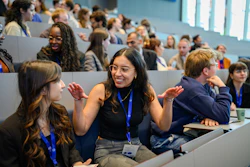
Connecting with fellow doctoral researchers across Europe.

Ademiku winning the Values and Impact Showcase, pictured with his fellow winners and the jury.
The Summer School was hosted by University College Dublin and the social programme introduced participants to Irish culture.
Can you share some memorable moments from this aspect of the Summer School?
On the first day, we had an Irish dance after dinner, called a céilí. Coming from the University of Edinburgh, I had been to a Scottish cèilidh before and I noticed that the dance is different but also similar, so it felt familiar to me. By contrast, we also tried hurling [Ireland’s official national sport for men, played with a stick and ball]. This was my first time playing hurling, and I enjoyed it so much.
The people [in Dublin] were so heartwarming, and the Summer School team were so fantastic and accommodating. We felt really welcome.
Aside from the Summer School activities, we also had the chance to go into the city. I visited the Museum of Literature to learn about James Joyce and his writing, as well as the nearby St Stephen's Green, which was so beautiful and filled with people. I was struck by how the people [of Dublin] really love nature. I was reminded that this is an aspect of sustainability as well – if the government in Dublin had not prioritised those green spaces, the city would not be as accommodating to people. It was so cool to see.
What is one lesson that you will take from the Summer School and apply to your own PhD research?
When communicating your research, make sure to focus on the aspect that matters most to the person you are communicating it to – not how much you feel or what you have done so far in your research, but how it connects to the person you are communicating to.
We learned about this during one of the sessions we had, which was very insightful. The professor shared how researchers typically communicate research, starting with introduction, then materials and methods, your results, the discussion of your research, and finally your conclusion. But when you’re communicating to, for example, a policymaker, the first thing you want to do is talk about your problem statement. Let them know what the problem is, then your solution, which is the results you achieved or aim to achieve. Now, the person is curious as to how you achieved or aim to achieve that – then you can share your method.
So my message is: Communicate your research in a way that touches the receiver.