What is the motivation behind the topic of this Winter School?
The Winter School aims to respond to today’s growing geopolitical concerns. If we take a look at European current affairs, the focus and agenda have clearly shifted, including the regulatory and legislative agenda. We have already held two Winter Schools. This edition directly reflects the shift in challenges Europe faces. The overarching theme, both last year and this year, has been “challenges.”
However, when we designed last year’s edition, which had in fact been planned in 2024, the context was different. At that time, European institutions were primarily focused on issues such as climate change and migration control. Security issues, in a broad sense, are now at the centre of the discussion. This includes defence, which is quite interesting as historically defence had been outside the European agenda, whereas now it is a central topic to understanding Europe’s position as a global actor.
How does the Europe and the World Self-Steering Committee (SSC) empower students to engage with Europe’s security challenges?
That’s a complex issue. There is no Una Europa SSC specifically devoted to defence or security, which is logical given the broad nature of the Europe and the World SSC. It is a peculiar SSC because it has a very open framework rather than a specific focus, which is both an advantage and a disadvantage.
The disadvantage is the risk of dispersion since we mainly come from economics, political science, law, and other social sciences, which implies that there is a wide range of possible topics. The advantage, on the other hand, is flexibility. When new issues arise, such as security, they can be analysed from multiple perspectives: legal, political, economic, including how they are financed. So, while there isn’t a dedicated security topic within the committee, through the Winter School we aim to bring this discussion to the table and provide students with foundational knowledge about these challenges, which helps reach new depths when seeking to understand the whole European security landscape.
" Perhaps if Una Europa were being created today, security would be seen as a topic substantial enough to merit its own committee. "
Diego Rodríguez, academic coordinator of Una Europa's Winter School 2026
Collaboration across national and academic contexts is at Una Europa's centre. How does it enrich talks on European security?
It enriches it in several ways. First, it provides a teaching space for students who may later work in European institutions or international organisations as in a regular academic course, it’s difficult to adopt such a multidisciplinary perspective.
Furthermore, in our working groups, professors from different backgrounds (economics, political science, law) collaborate. We also combine academia, public administration, and the private sector in roundtables. This interaction across disciplines and sectors is extremely valuable both for professionals but more so for the participating students.
Considering that the geopolitical landscape has changed radically in recent years – the war in Ukraine, the Trump effect, shifting alliances, diversification of supply chains – security is now at the centre of European debate and budgeting, more so than agriculture or even climate change. Therefore, as the nature of security challenges is multifaceted, they cannot be understood from just one perspective, which means that students, academics and our universities are able to build a more complete understanding of the topics at stake with this collaboration across different national and academic contexts.
Has your involvement in Una Europa influenced the way you think about Europe’s role in global security debates?
It certainly broadens your perspective. As academics, we tend to specialise deeply. For example, I recently presented research on nuclear phase-out in Spain. That may be relevant for Spain but not for France. However, interacting with colleagues from other disciplines and countries is tremendously useful as it exposes you to complementary approaches and opens your eyes to research paths that you may have not contemplated as a possibility before. Therefore, although academic careers require specialisation, initiatives like this allow you to broaden your focus and maybe even see things more clearly thanks to it.
As an academic involved in Una Europa, what motivates you most about being part of this alliance?
For me, it’s the personal relationships you are able to foster. As an academic and as an individual you can connect with people you would never naturally encounter within your academic specialisation. I usually work with economists and engineers, but here I get the chance to collaborate with political scientists, for instance. The Europe and the World SSC allows for almost any topic and any cooperation to arise. I must say that I was somewhat sceptical initially, but I now see the advantage: it allows adaptation to evolving global realities.

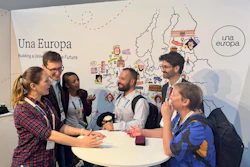
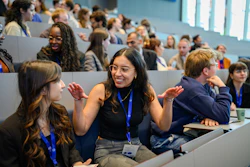
Diego Rodríguez with the participants of the "Europe and the World Winter School 2026: Security Challenges for the EU in Turbulent Times" at UCM.