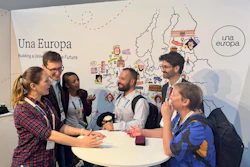
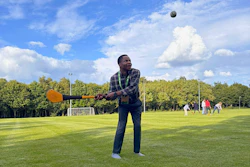
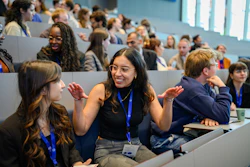
Valeria, Romane, how did you come to be involved in Una Europa?
Valeria: I was introduced to Una Europa some years ago through another student association at Uniwersytet Jagielloński. When the Una Europa Local Student Task Force (LTF) was first created, many people joined from this association because it was made up of people who were already interested in international affairs, cooperation, and these types of projects. So we naturally moved towards Una Europa.
My first mobility experience with Una Europa was the Student Congress in Helsinki, which I attended as a participant. At that time I was the LTF Officer at Uniwersytet Jagielloński, the person who is responsible for logistics for the LTF, so the Congress was a very nice experience because it showed me that what we were doing at our university was also being done at other partner universities. This is what motivated me to go into the Student Board – to be able to see the work of students replicated everywhere across the alliance.
Romane: I met Una Europa three years ago through the certificate in European Studies, in which I attended some classes with students of the BAES [Una Europa Joint Bachelor in European Studies]. I followed the certificate programme for two years before I got involved in the LTF at Université Paris 1. At that time I already knew the two Student Board members, so I had a sense of what was going on in the Student Board and that made me interested in joining it. The year after, I was selected for the Student Board and I went to the Una Europa Student Congress in Berlin, which was my first international experience with the alliance.
What made you interested in Una Europa and want to get involved?
Romane: For me, the first thing was that the certificate in European Studies was in English, and that everything around Una Europa was in English. In Paris, it is not a common thing to speak in English and gain that international perspective, so the international and linguistic aspects really interested me.
Valeria: I agree, the international aspect is the first hook Una Europa gives to students.
But for me, more than anything, I was interested in seeing people on ‘the other side of the computer’ also doing similar things to us and being able to talk about it. It was not a call in only one direction, but an actual conversation. I was already involved in student associations that were interested in international topics, but it’s different to be able to talk to someone in a different country about that. For me, that was the most convincing aspect of Una Europa: to have someone on the other side, also working on the same things, to talk to and learn from each other.
" We want to start by encouraging bottom-up projects from students by connecting the Local Task Forces at the different partner universities. We want to facilitate cooperation between students beyond their own university, and have the students be part of the conversation. "
Valeria Quintana-Solis on how the Student Board will empower more student across the alliance to co-create Una Europa's student opportunities.
What motivated you to take on the role of Student Board Co-Chair?
Valeria: Romane, myself and Daniel [Student Board Secretary] are the ‘oldest’ of the current Student Board, because we also sat on the Board last year and so we already had some experience and could bring some continuity to the Board. It felt like a very natural choice for us to become Co-Chairs, it was a very organic process.
Romane: Yes, it felt very natural for us to become this key reference point and contact for the Student Board, sort of like an older sister. If a member of the Student Board has a question, we are here to help. That is really how I see our role as Co-Chairs – to help people understand what we are trying to do as the Student Board and to continue the work of last year.
Valeria: The Student Board operates very much as a group, with everyone working together on the same level. So we really want to thank the whole Student Board for their work, because it really is a group effort and it’s a pleasure to be able to work together like that.
What topics are the Student Board focusing on this academic year?
Romane: At the beginning of this academic year, in the autumn, our main focus was on the Student Board Action Plan. The Action Plan was voted on, adopted, and presented and approved by the Board of Directors [in October 2025]. Now the next step is to put the Action Plan into action.
We have a lot of ideas and projects planned regarding students in Una Europa, but one thing I really want to see before I leave the Student Board is better support to the LTFs, whether they are coming back to life or just growing. The question of alumni and the onboarding/offboarding procedure for LTFs is really important, to understand what has happened over the year and how the work can be taken forward. This is the main thing for me.
Valeria: The Action Plan is our main guide for what we are planning to do for the next two years. It is about the true engagement of students, not only in terms of giving them opportunities to travel or new educational programmes, but to really get students involved in the creation and planning of these activities. We want to help students be not just receivers of these opportunities, but also co-creators. The Action Plan really has that as a main motivation – to make students into co-creators of the future of education.

The Una Europa Student Board 2025/26.
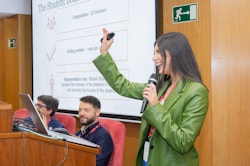
Valeria presenting at the Una Europa General Assembly at Universidad Complutense de Madrid in October 2025.

Romane with other members of the Student Board participating in the Una Europa General Assembly at Universidad Complutense de Madrid in October 2025.
How will the Student Board facilitate positioning students as co-creators?
Valeria: We have a lot of ideas, but we want to start by encouraging bottom-up projects from students. For example, the Student Visual Art Contest was fully initiated and realised by students, with the support of the Una.Futura project. These bottom-up initiatives are very important and we are trying to encourage more of them, specifically by connecting the LTFs at the different partner universities. We want to facilitate cooperation between students beyond their own university, and have the students be part of the conversation.
From your perspective, what can other alliances learn from the Una Europa Student Board?
Valeria: All alliances have some type of student body; however, I think in Una Europa we are very well-organised and that makes the Student Board a strong governance organ for the alliance.
The fact that we, for example, have written our own Statutes, Code of Conduct, Strategy and now an Action Plan by ourselves speaks to how much ownership and trust the Student Board has in deciding and realising our own goals. There are a lot of ways that Una Europa has supported students to make their own decisions, instead of providing them with a to-do list of tasks to complete. Una Europa is giving the space for us as the Student Board to do our own things.
Another thing I would say is that alliances need students in their governance, because without students, universities would not exist. Students are the heart and the passion behind universities, so it is important that student voices are included in governance conversations. Mobility, quality of education, all of these topics directly impact students, so students need to be part of the conversation.
Una Europa has done very good work in this area – for example, we are the only alliance that have regular meetings between the Student Board and the Board of Directors. We are also the only alliance student body that meets as frequently as three times per year. So I think when it comes to governance, Una Europa does practice what it preaches. There is definitely space to do more, but we are heading in the right direction in trusting students with their own decisions and their own future.