Kiira, you are the brain behind the Una Europa Research Simulator. What challenge did you set out to address with this idea?
When I look back at the path that led me to my PhD, I see that although my educational background was quite research-based compared to other fields, my research experience during my bachelor’s was very limited. Through completing my master’s thesis, getting my first research assistant job, and even now that I’m at the end of my PhD, I am still learning how to ‘do’ research. This experience made me think, there is no real reason why research skills cannot be taught earlier in undergraduate studies, encouraging students to think like researchers from an early stage.
I have also been lucky enough to gain international experiences – I participated in exchange programmes in central Europe during my master’s, supported by Erasmus+, and I have conducted research visits in Australia during my PhD – but I understand that such opportunities are not accessible to everyone. So it was important to me to make the Research Simulator as accessible as possible, which is why I wanted to implement it online.
I also wanted to bring multidisciplinary aspects into the Research Simulator. My background is in cognitive science, which is quite multidisciplinary as it combines areas such as psychology, philosophy, computer science, and linguistics. As part of my studies, I had the freedom to choose my own courses, so I was able to study across different faculties of my university [Helsingin yliopisto/Helsingfors universitet]. I really enjoyed that. Overall, I feel that a multidisciplinary and multicultural environment is the most fun and fruitful – you meet people with different backgrounds, and you learn so much about what you’re good at, but also new ways to think about your research and about life in general.
With the Research Simulator, I wanted to reflect on my own journey from a student to a researcher and bring all these aspects together to create something new, something that can live its own life.
What motivated you to bring the Research Simulator into the Una Europa context?
Una Europa ticks all the boxes of what I enjoy – the international and multidisciplinary environment, which brings people together from different cultures. I find this especially rewarding in the European context, where English is not the native language for most people.
The Student Award was something really fun, that let me be creative. It was really nice to focus on something beyond my research, and to take a moment and plan something different for the students across the Europe.
" One of the biggest strengths of Una Europa is that it can offer these unique opportunities for collaboration across universities. It’s great to be able to connect and work with students in different countries, to gain a true international experience without leaving your home. "
Kiira reflecting on the value and impact of her Una Europa Student Project Incubator programme.

Your Research Simulator was piloted in the context of the Una Europa Student Project Incubator.
How did you find the experience of co-creating this programme?
It was so much fun, I really enjoyed it. Stinne [Vognæs, Senior Project Lead for Student Empowerment, Una.Futura] and I got along like a house on fire, and we complemented each other really well. She knew everyone in Una Europa and had run Incubator programmes before, which was extremely helpful. She also has this infectious energy to encourage you to work together and keep going.
One thing I really liked was the flexibility. As a researcher, you are used to applying for a grant with a very specific idea in mind, with little room to adjust the plan as you go. Working on the Student Project Incubator felt more like a start-up, where you could make changes as the programme progressed.
For example, after the programme started I saw an opportunity to offer other PhD students some teaching experience in a relaxed, supportive way, by engaging them as mentors to co-run the sessions. We ended up with a really nice group of mentors, and we actually became good friends. Some of the changes happened fast, but I was so impressed with how everyone, including the students who participated, understood what we were doing and worked together to run the Incubator so smoothly. I felt really empowered that I could make that change during the programme, that we could be adaptable and flexible in that sense. There was room to evolve.
During and after the Incubator, I felt so empowered to see my vision come together through everyone’s work. There was so much room to evolve, and it was really nice to see everyone come together and keep the momentum going.
What did you hope that participants would gain from the Student Project Incubator?
If a student is looking for something new and a bit outside of the box, and wants to be part of creating something new, the Incubator can help them do that.
One of the biggest strengths of Una Europa is that it can offer these unique opportunities for collaboration across universities. It’s great to be able to connect and work with students in different countries, to gain a true international experience without leaving your home. It’s one of my favourite things in academia; to meet people across the globe, who share your passion but bring different perspectives that you can learn from.
What’s next for the Research Simulator?
I am glad you asked! In fact, the timing couldn’t have been better – as the Incubator was coming to an end and we were reflecting on ways to improve and evolve the programme, a call opened for Una Europa Seed Funding. I managed to connect with some researchers across Una Europa via a Seed Funding LinkedIn group, researchers who shared the same passion and similar ideas for an incubator. So, I am happy to tell you that there will be another series of incubators later this year, looking a little bit different, supported by Una Europa Seed Funding. I am excited to work again with some of the mentors and bring some lessons from my Student Project Incubator programme, but also to meet new people, learn new things, and build something great together.

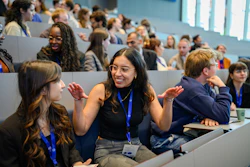
Kiira (middle) at the Una Europa Student Congress 2024 in Berlin with the other winners of the Una Europa Student Award 2024.
Kiira is involved in E-FLIRT: European Future Literacy Incubator for Research and Transformation, one of ten projects that was awarded Una Europa Seed Funding in our 2025 Call.
Applications for the spring 2026 edition of the Una Europa Student Project Incubator are open now. Visit the dedicated webpage to find out more and apply.