Gerardine, you're a pharmacologist, a chartered accountant and a chartered tax advisor with a strong interest in One Health.
Tell us how interdisciplinarity has shaped your career.
Having expertise in the disciplines of both medicine and management has provided me with a unique intellectual signature in academia.
Being able to speak the language of both disciplines has enabled me to collect real-world data to understand what drives costs in healthcare delivery, while speaking with credibility to both clinicians and senior financial experts.
Most importantly, it has led to my being invited to be a principal investigator in numerous large EU comparative studies addressing a range global health challenges – including Type 2 diabetes, dementia, childhood obesity, maternal and infant mortality and inequities in healthcare.
What I bring to each of these studies is my expertise in measurement: measurement of cost, measurement of patient-reported outcomes, measurement of value in how we deliver our healthcare services, and measurement of health literacy.
As academic lead for the One Health Summer School, what's one lesson you hope participants will take away from the experience?
[The lesson of] valuing diversity of thought: learning how theories and practices may be brought from one discipline and applied to another to solve our global problems. So, for example, in our One Health Summer School, researchers are going to be exposed to learnings not only from life sciences, but also from a sociological perspective, a geography perspective, a legal perspective, and indeed a public health perspective.
Understanding the interconnectedness of environmental, economic, geopolitical and societal challenges and their impact on the environment and on human and animal wellbeing – that's really the key.

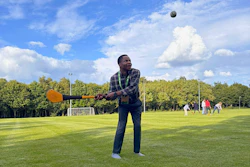
Summer School participants at Lyons Farm, a teaching and research facility run by UCD.
A key feature of the three Summer Schools taking place at UCD is the crossover events bringing all participants together.
Why was it important to include these in the programme?
[UCD hosted three Summer Schools – Artificial Intelligence and Creativity, Sustainability for All, and One Health for All – concurrently from 15–19 Jun 2026.]
The thinking behind this is that global societal challenges cannot be solved through a single lens or discipline. Learning from each other across the three summer schools reinforces this idea. Working across disciplines, bringing together different expertise and approaches to solve problems, really enriches the doctoral research journey.
There are also natural overlaps across these themes. For example, the connection between One Health and sustainability is reflected in sustainable food systems. And in both our research and our daily lives, we collect vast amounts of data; data science and AI can help facilitate its analysis.
Our research can also shine a light on vulnerable groups in society, helping us as researchers focus our attention where it is most needed. The recent Lancet One Health Commission highlights that One Health is interdisciplinary, transdisciplinary and multisectoral in its approach to addressing global sustainability challenges. It therefore makes sense to bring these three groups of doctoral students together to learn from one another, and to better understand this interconnectedness – that no single discipline or sector can solve these complex challenges alone.
Tony Houlihan (Director of UCD Centre of One Health) recently said:
“We do not have a One Health knowledge problem. [We have a] One Health implementation problem.” Does this resonate with you?
It certainly does. The One Health approach is not new to us; it dates back to the early 2000s. There is an extensive body of research and literature on One Health. While we have lots of data on our global challenges – for example, on the risk of pollution, extreme weather conditions, social inequities – we are not connecting the data effectively to develop policies that will then address these problems. That’s where implementation is important: to move beyond our siloed approach and data collection, to develop deep vertical expertise that can inform policy development.
Ireland has recently established a One Health Oversight Committee. It is a cross-government, inter-agency and all-Ireland group that is advising government and relevant departments on best practice, using a One Health approach around policy and strategic direction in relation to our emerging threats that will pose risks to human health, animal health and the environment. This is a very exciting development in Ireland – we're getting that interconnected, cross-disciplinary thinking at policy, government and agency level.
If you had to describe the spirit of the Una Europa One Health community in one word, what would it be and why?
Interconnectedness. That applies both from an academic perspective, reflecting the interconnectedness at the heart of the One Health concept we've been discussing, and in terms of the community itself. As a group of experts coming together, it is a very collegial environment