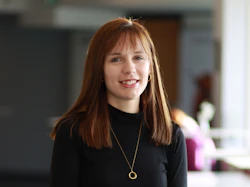
Sophia, how does it feel to take on the mantle of Una Europa Secretary General?
It’s incredibly exciting – still a bit surreal, I have to admit. At the same time, it feels like a natural step for me. Even so, it’s not something you ever really expect to happen, or at least I never did. It's a new challenge that allows me to keep growing, which is fundamental to how I see work and how I see myself in my job.
A big part of the role of the Secretary General is to work with the amazing colleagues we have in Brussels, because this is not a job that you can – or should – do alone. The alliance is very lucky to have this group of committed people who understand the collaboration so well and who always uphold our shared values and our common strategy.
You’ve been working with Una Europa for five years – a long time in alliance terms! What milestone stands out the most to you?
Since taking on the Interim Secretary General role, I’ve found myself thinking back to the very beginning. I was lucky to come into this alliance very early on when there was so much excitement and enthusiasm.
I keep thinking back to our 1Europe project final event [Voyage to a University of the Future in November 2022]. That was such a big alliance milestone – the biggest event we've ever had here in Brussels. It allowed us for the first time to show who we are and what we've done, and really shine a spotlight on the people behind the scenes.
Now we’re planning the conclusion of our Una.Futura project [in November 2026] and we're asking that same question: how do we put the spotlight on the people behind the scenes? How do we make people feel visible and heard and seen?
" The role of Secretary General is fundamentally the role of a facilitator. It's about being able to listen to people, to make people feel at ease – and comfortable in the uncomfortable, sometimes. Because we are all working outside our comfort zones. "
Sophia Karner, Una Europa Secretary General

And is there an achievement of yours in that time that you’re particularly proud of?
Something that is top of mind at the moment is the work that I've done on the European degree in the past five years [as Senior Policy Officer]. When I first started, it was one of the first things I had to get to grips with – and at that moment, it was such an unknown.
The main beauty – and challenge – of this policy is that it still can mean very many different things to many different people. As Una Europa, we have always tried to work on the European degree as a way to provide a unique learning experience for students on the one hand, and, at the policy level, find a way to make the European Higher Education Area into something more cohesive and less complex.
We just submitted an application for another project [the European Degree Exploratory Action call], which we're hoping will allow us to dedicate extra resource to student services and student support measures and make our joint programmes more inclusive and accessible.
European degree principles are very prominent in our joint programmes, and that's not an accident. They’re such exemplary, innovative programmes, they provide a model of what the European degree can be. It's really one of the areas where I feel the most impact of my work over the past years.
If you were a student today, which of our Una Europa programmes would you enrol in and why?
Because of where I come from, professionally and personally, I think I would have to go for the Joint Bachelor in European Studies (BAES). I find European decision-making and policymaking very exciting and interesting, and I'm somebody who's very interested in politics as well, in my own country [Austria] and at European level.
The fact that you can move across two, three partner universities is still something that I find so unique. I did an Erasmus semester during my Bachelor’s and then completed my Master's in the UK, so I suppose I've also had a little bit of mobility in my study experience. But I think the way mobility is integrated into one programme is really something quite amazing.
Having now had the privilege to know some of the BAES students and the learning experiences that they've had, the confidence it's given them, the exposure to different ways of teaching and learning…I personally find it very exciting.
The Secretary General plays a key role in steering the alliance towards a common mission. How do you foster unity in diversity?
For me, the role of Secretary General is fundamentally the role of a facilitator. It's about being able to listen to people, to make people feel at ease – and comfortable in the uncomfortable, sometimes. Because we are all working outside our comfort zones, outside of our usual ways of doing things. It takes somebody who's able to bring people together in a very open and accepting way.
It’s also sometimes about naming things that are difficult or challenging, and put them openly on the table to try and find solutions together.
This goes to the core of how I would like to do things going forward. I think challenges are much better addressed when they're openly discussed. We might not always be able to find the solution instantly, but sometimes even agreeing on the same challenge is a first step. When everybody sees the same hurdles, that's already the first step towards a solution, in my opinion.
The main thing in an alliance is not only trust between people, but trust between the bodies and groups of the alliance. It starts with building relationships among individuals, but ultimately, we want to build a very resilient and sustainable system as an alliance where there is clarity on the responsibility of each part in the beautiful setup that we create.
Among the Brussels team, you're known as the office bookworm. Any recent reads you'd recommend to alliance colleagues?
I recently read Ernest Hemingway’s A Moveable Feast, which was inspired by my latest trip to Paris in January. It’s essentially a diary of his time in the city. I really loved it because having just been to Paris, I could feel the different locations he describes.
It's a very nice description of a Paris in a very different time. Hemingway lived at a time when there were lots of other writers, thinkers and artists living in Paris too. I would really recommend it to colleagues ahead of the General Assembly in Paris next month at Université Paris 1 Panthéon-Sorbonne. Maybe it's even nicer to read it beforehand – you’ll feel the stories when you walk the streets.